
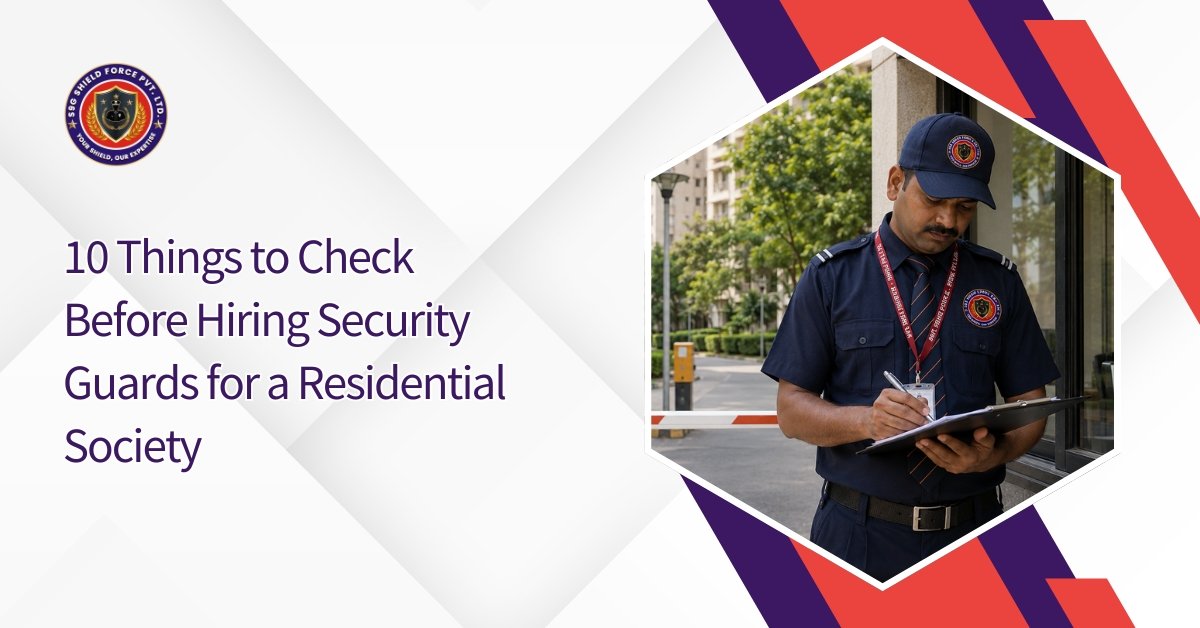
Summary– Hiring a security guard for your residential complex requires more than simply checking uniforms and IDs. You need trained professionals who understand access control, visitor management, emergency response, and community-specific safety needs. This checklist walks you through the top 10 things to verify licensing, background checks and agency reliability to help housing societies choose the right residential security guard service in your area.
Security is a major concern for residential societies, where residents, children, senior citizens, visitors, domestic workers, delivery personnel, and vehicles enter and exit the premises every day. Hiring security guards is not simply about choosing the lowest-cost service provider.
To help society managers, committee members, and residents make informed decisions, here’s a clear and practical 10-point checklist. It covers everything you need to verify from licenses and training to communication skills and agency reputation so you can hire a security guard who truly keeps your community safe.
Why Hiring the Right Security Guard Matters for Residential Safety?
Choosing the right security guard for your residential complex is one of the most important decisions any housing society can make. A guard is not just a person in uniform they are the first line of defense for your community. Families trust them with their safety, their homes, and their daily routine. That’s why a skilled, trained, and alert guard makes a huge difference in how safe residents feel.
Professional security also improves the overall experience of living in a housing society. Well-trained guards are polite, responsible, and consistent. They help residents feel respected, welcome, and protected. For families with children, senior citizens, or people living alone, this sense of safety is priceless.
Difference Between Hiring Directly vs. Hiring Through a Security Agency
- Hiring Directly
Hiring a security guard directly means the residential society recruits the guard on its own. The society becomes responsible for everything background verification, police clearance, training, attendance, salary, leaves, replacements, discipline, and compliance with laws. While direct hiring may seem cheaper, it often leads to challenges like untrained guards, no backup when a guard is absent, and difficulty handling misconduct or emergencies.
- Hiring Through a Security Agency
Hiring through a professional security agency is usually more reliable and hassle-free. Agencies provide trained, PSARA-licensed guards with verified backgrounds and ongoing supervision. They handle payroll, shifts, replacements, uniforms, and performance monitoring. If a guard takes leave or needs to be replaced urgently, the agency sends another guard without disrupting security. A good agency also offers SOPs, patrolling systems, emergency-response training, and quick escalation support. Although the cost may be slightly higher, you get better safety, consistency, and accountability for your residential complex.
10 Things to Check Before Hiring Security Guards
1. Assess Your Society’s Security Requirements
Before hiring security guards, understand the specific security needs of your residential society. Consider the number of entry and exit gates, parking areas, visitor traffic, common spaces, delivery movement, and areas that require regular patrolling. This helps determine the right number of guards and suitable deployment for each shift.
2. Verify the Security Agency’s Credentials
Check the security agency’s licence, registration, experience, and other applicable credentials before hiring. A reliable agency should be able to provide relevant documentation and clearly explain its services, deployment process, and compliance practices.
3. Check Background Verification
Background verification is important when hiring personnel who will interact with residents and have access to the society premises. Ask the agency whether deployed guards have undergone proper identity and antecedent verification and whether the required records are maintained.
4. Evaluate Guard Training
Security guards should have appropriate training for residential environments. Check whether they are trained in access control, visitor management, emergency response, fire safety, communication, basic first aid, conflict handling, and incident reporting. Proper training helps guards respond more confidently and professionally.
5. Look for Residential Security Experience
Experience in residential society security can be an important advantage. Guards working in housing societies need to manage residents, visitors, domestic workers, delivery personnel, vendors, and vehicles while maintaining a professional approach. Ask the agency about its experience with similar residential properties.
6. Confirm 24/7 Coverage and Replacement Support
If your society requires round-the-clock security, confirm that the agency can maintain coverage across all shifts. Also ask about its replacement policy in case a guard is absent, takes leave, or leaves the deployment. Reliable backup support helps prevent security gaps.
7. Check Regular Supervision
Security guard performance should not depend only on the guards stationed at the property. Ask whether the agency provides supervisors who conduct regular site visits, monitor attendance, review guard performance, and address issues reported by society management.
8. Evaluate Technology and CCTV Skills
Modern residential societies often use CCTV cameras, access-control systems, visitor-management software, intercoms, and other security technologies. Check whether the guards are capable of operating the systems relevant to your society and reporting suspicious activity or technical issues appropriately.
9. Compare Pricing and Contract Terms
Cost is important, but the lowest quotation may not always provide the best value. Compare the overall service package, including manpower, shift coverage, supervision, training, replacement support, uniforms, equipment, and other inclusions. Carefully review the contract terms before finalizing the agency.
10. Check Emergency Response Capabilities
Ask how the security team handles emergencies such as fire, medical incidents, accidents, unauthorized entry, or other security threats. Guards should understand the society’s emergency procedures, know how to guide residents to safety when required, and understand when and how to escalate incidents to the appropriate authorities or emergency services.
🏢Ready to Hire Reliable Security Guards for Your Residential Complex?
Protect your residents, safeguard your property, and ensure peace of mind with trained, verified, and professional security guards. ✅Partner with a trusted security agency that offers experienced staff, 24/7 support, and seamless integration with modern security systems.
Don’t compromise on safety get in touch today to discuss your requirements and secure your residential community with professionals you can rely on!
📞 Contact us now and make your society safer, smarter, and stress-free.🏘️🔒
Frequently Asked Questions
Ask the security agency to confirm that the guard has undergone proper identity and antecedent verification. The society can also review relevant verification and employment records provided by the agency.
Residential security guards should be trained in access control, visitor management, emergency response, fire safety, communication, basic first aid, conflict handling, patrolling, and incident reporting.
Hiring through a professional security agency can provide access to trained personnel, supervision, replacement support, and structured security management. Direct hiring may give the society more control but also increases its responsibility for recruitment and management.
The required number depends on factors such as the number of gates, society size, visitor traffic, parking areas, patrolling requirements, and whether 24/7 coverage is needed. A site assessment can help determine the appropriate deployment.
A contract should clearly mention manpower, duties, shift timings, service charges, supervision, replacement arrangements, training, equipment, responsibilities, reporting procedures, and termination or escalation terms.
A reliable security agency should have a replacement or backup arrangement to maintain the required security coverage. Before hiring, the society should confirm the agency’s absence and replacement policy.