
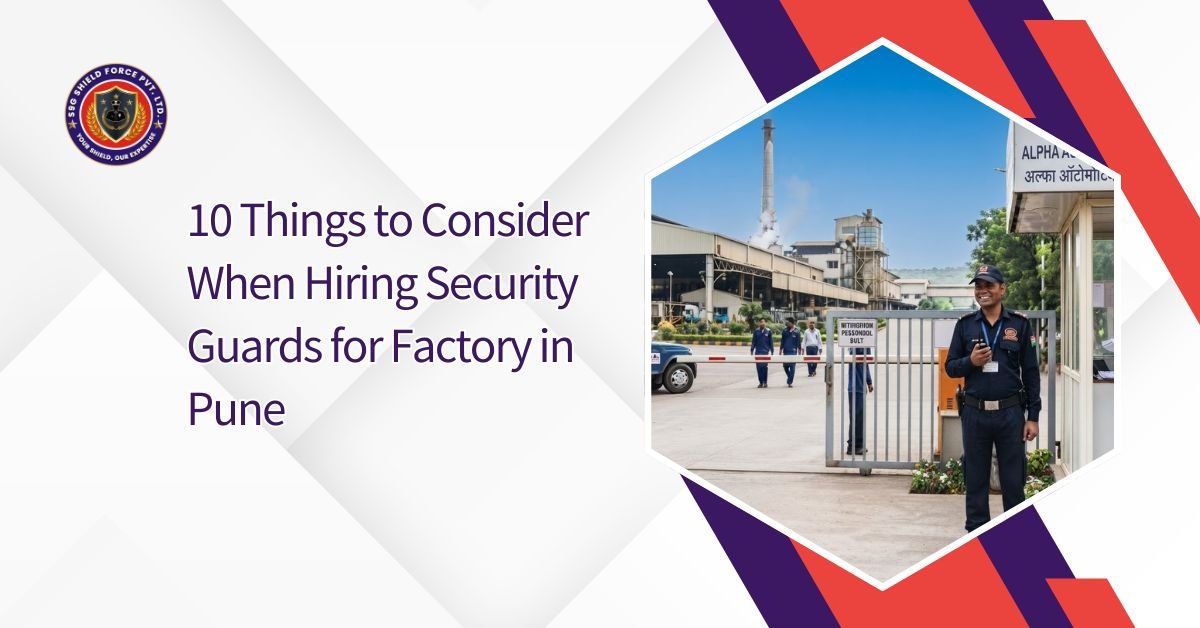
Summary : Hiring security guards for a factory is not simply about placing personnel at the main gate. A manufacturing facility may have multiple entry points, employees, contractors, visitors, vehicles, raw materials, finished goods, machinery, warehouses and restricted areas that all require proper monitoring. This article explains 10 important factors to consider before appointing a security agency.
Factories have a different security environment from offices, shops or residential premises. Employees may work across multiple shifts, vehicles can enter and leave throughout the day, contractors may require temporary access, and valuable materials can move between production, storage and dispatch areas.
Guards may be responsible for checking people at entry points, monitoring vehicle movement, maintaining visitor records, watching sensitive areas, supporting emergency procedures and reporting unusual incidents to management. For this reason, factory owners should look beyond the number of guards offered and assess the agency’s licensing, training, industrial experience, supervision, compliance practices and replacement arrangements.
10 Key Factors To Consider Before Hiring Factory Security Guards in Pune
1. Check The Valid PSARA License
One of the first things to verify is whether the security agency holds the applicable PSARA licence. Private Security Agencies Regulation Act (PSARA), 2005 regulates private security agencies in India, and the Ministry of Home Affairs explains that PSARA licences are issued by the relevant State or Union Territory Controlling Authority.
Before entering into an agreement, ask the agency to provide its licence details and check that the licence covers the area in which security services are being provided. It is also sensible to keep copies of relevant documents as part of your vendor records.
Licensing should be treated as a basic screening requirement rather than an optional extra. A professional agency should be comfortable explaining its regulatory status and providing supporting documentation.
2. Verify Statutory Labour Compliance
Security services are manpower-intensive, so labour compliance should be considered when comparing agencies. Do not evaluate a quotation only on the monthly amount per guard. Ask how the agency handles applicable wages, provident fund, ESIC, professional tax, bonus and other statutory obligations.
You can also ask for appropriate records or supporting documents as part of your vendor evaluation. This helps your organisation understand whether the proposed deployment is built around a compliant employment structure.
A very low quotation may look attractive at first, but unclear statutory practices can create avoidable problems later. A transparent agency should be able to explain what is included in its commercial proposal and how manpower costs are managed.
3. Look For Industrial Security Experience
A factory is not an ordinary security post. Guards need to understand how industrial premises function, including shift changes, loading and unloading, contractor movement, material dispatch, restricted areas, parking zones, warehouses and production areas.
Ask whether the agency has experience with manufacturing units, industrial plants or similar facilities. More importantly, discuss the type of duties guards will perform at your site.
Industrial experience can make it easier for personnel to follow established procedures, recognise unusual activity and coordinate with plant supervisors. The agency should also be able to understand your operating hours and recommend deployment based on the actual layout and risk points rather than simply assigning a standard number of guards.
4. Check Background And Police Verification
Security guards interact with employees, contractors, visitors and drivers and may access sensitive areas. Before deployment, verify that the agency follows a proper process for identity checks, background screening and police verification, along with relevant employment and training records.
The Ministry of Home Affairs’ PSARA framework includes antecedent verification for private security personnel. Choose an agency that maintains proper documentation and can clearly explain its verification process instead of relying only on verbal assurances.
5. Ask About Fire Safety And Emergency Training
At an industrial site, security guards may be among the first people to notice smoke, a fire, an accident, an unauthorized entry or another urgent situation. Their training should therefore go beyond routine gate duties and include basic fire and emergency management procedures.
Guards should understand how to raise an alarm, contact the appropriate emergency personnel, guide people toward designated safe areas, report incidents promptly and follow the factory’s emergency response plan. Training may also cover basic first aid, evacuation support, emergency communication and coordination with the internal safety team.
The goal is to ensure that security personnel know how to respond calmly and correctly during the initial stages of an emergency while following the factory’s established safety procedures.
6. Evaluate Access Control And Gate Management
For many factories, the main gate is the first and most important security checkpoint. A well-run gate management process can help control employee, visitor, contractor and vehicle movement.
Ask whether the security team can manage:
- Employee entry and exit
- Visitor identification and records
- Contractor verification
- Vehicle checks
- Delivery and dispatch documentation
- Material movement records
- Temporary passes
- Restricted-area access
The process should be practical enough to maintain security without creating unnecessary delays for legitimate employees, suppliers or customers.
For larger facilities, access control may also need coordination with CCTV, electronic systems and internal approval procedures. Clearly written gate protocols help guards apply the same standards across every shift.
7. Consider Local Language Proficiency
Good communication can make a significant difference at an industrial site. Guards may need to speak with employees, supervisors, drivers, contractors, vendors and visitors throughout the day.
Depending on your workforce and operating environment, practical knowledge of Marathi, Hindi and basic English can be useful. The important factor is not the number of languages listed on a profile, but whether guards can understand instructions and communicate clearly when something requires attention.
Language ability is especially valuable during emergencies, shift handovers and access-control situations. A guard who can confidently communicate with the people around the factory is more likely to understand instructions correctly and escalate issues without unnecessary confusion.
8. Demand Clear Service Level Agreements (SLAs)
Before deployment begins, discuss Service Level Agreements (SLAs) with the security agency and make sure the responsibilities of both parties are clearly documented. The agreement should explain what the agency is expected to provide and how service performance will be monitored.
The agreement should clearly define areas such as:
- Number of guards and duty posts
- Shift timings
- Supervisor responsibilities
- Attendance and reporting
- Uniforms and basic equipment
- Replacement arrangements
- Incident escalation
- Service expectations
- Billing and payment terms
- Notice and termination conditions
A clear SLA reduces misunderstandings. It also gives factory management something concrete to refer to when reviewing service quality.
Do not accept vague statements such as “24×7 support” without asking what that support actually means. Clarify who can be contacted, how quickly concerns are escalated and what happens when a post becomes vacant.
9. Check Supervisor Visits And Relief Cover
A factory can have excellent guards on paper and still face problems if there is weak supervision. Ask how often supervisors visit your site, whether night inspections are conducted and how shift handovers are monitored.
Supervisors may help with:
- Post inspections
- Attendance checks
- Discipline monitoring
- Incident review
- Night rounds
- Management reporting
- Training reinforcement
- Client communication
Relief cover is equally important. Guards take leave, become unwell or may occasionally be unable to report for duty. Ask exactly what the agency does in those situations.
A dependable replacement system prevents critical posts from being left unattended. For factories that operate multiple shifts, this can be just as important as the initial guard deployment.
10. Confirm Comprehensive Insurance Coverage
Insurance and liability should be discussed before the service agreement is signed. Ask what insurance coverage the agency maintains and what responsibilities are assigned to the agency and the client under the contract.
Review relevant documents carefully rather than assuming that a general insurance statement covers every possible situation.
Questions worth asking include:
- What policies are maintained by the agency?
- What period of coverage applies?
- What risks are included or excluded?
- What are the responsibilities of the client?
- How are incidents reported and documented?
- What supporting documentation is available?
The exact coverage required can vary according to the nature of the site, contractual terms and applicable requirements. Clear documentation helps both sides understand their responsibilities before an incident occurs.
Secure Your Factory With The Right Security Team
Ready To Strengthen Your Factory Security? The right guards can make every gate, shift and movement more accountable. S9G Shield Force Pvt Ltd provides professional security support designed around the practical requirements of factories, warehouses and industrial premises. If you are looking for a factory security guards agency in Pune, speak with our team about your site requirements and deployment needs.
From gate control to routine vigilance, make security part of a stronger factory operation. Contact today to discuss your security requirements with our team, understanding the right deployment options, and planning dependable security coverage for your premises.
Frequently Asked Questions
Private security agencies in India are regulated under the Private Security Agencies (Regulation) Act, 2005. The Ministry of Home Affairs states that a private security agency requires a licence under the Act, with licences issued by the relevant State or Union Territory Controlling Authority.
Training should match the duties of the site. Depending on the factory, this may include access control, visitor management, fire safety awareness, first aid, emergency response, incident reporting and site-specific security procedures.
There is no fixed number suitable for every factory. The requirement depends on factors such as the number of gates, operating shifts, factory size, perimeter, vehicle movement, warehouse areas, restricted zones and required patrols.
Yes, factory security guards should receive basic fire safety training. They should know how to raise an alarm, contact the appropriate emergency team, guide people toward safe exits and use basic firefighting equipment when trained and authorised to do so.
A factory security service agreement should include the number of guards, duty posts, shift timings, responsibilities, supervision, uniforms and equipment, replacement arrangements, reporting procedures, escalation contacts, billing terms and termination conditions.
Professional industrial security guards can be trained to respond to emergencies such as unauthorized entry, theft, fire incidents, workplace disturbances, and other security situations according to the facility’s security procedures.